

It comes around once a year. Thursday after lunch. Your boss is calling you, probably about something you forgot to do. Wait, is the sky being ripped apart? Is this the London Blitz?! Suddenly those TPS reports don’t seem that important.
The first time Goose and Maverick buzz the tower can be thrilling. The thirtieth time is obscene. Nearly one in five complaints Chicago 311 receives—over 900 a day—is an aircraft noise complaint, so I figured the Air & Water Show must double those numbers, right?
Yes and no.
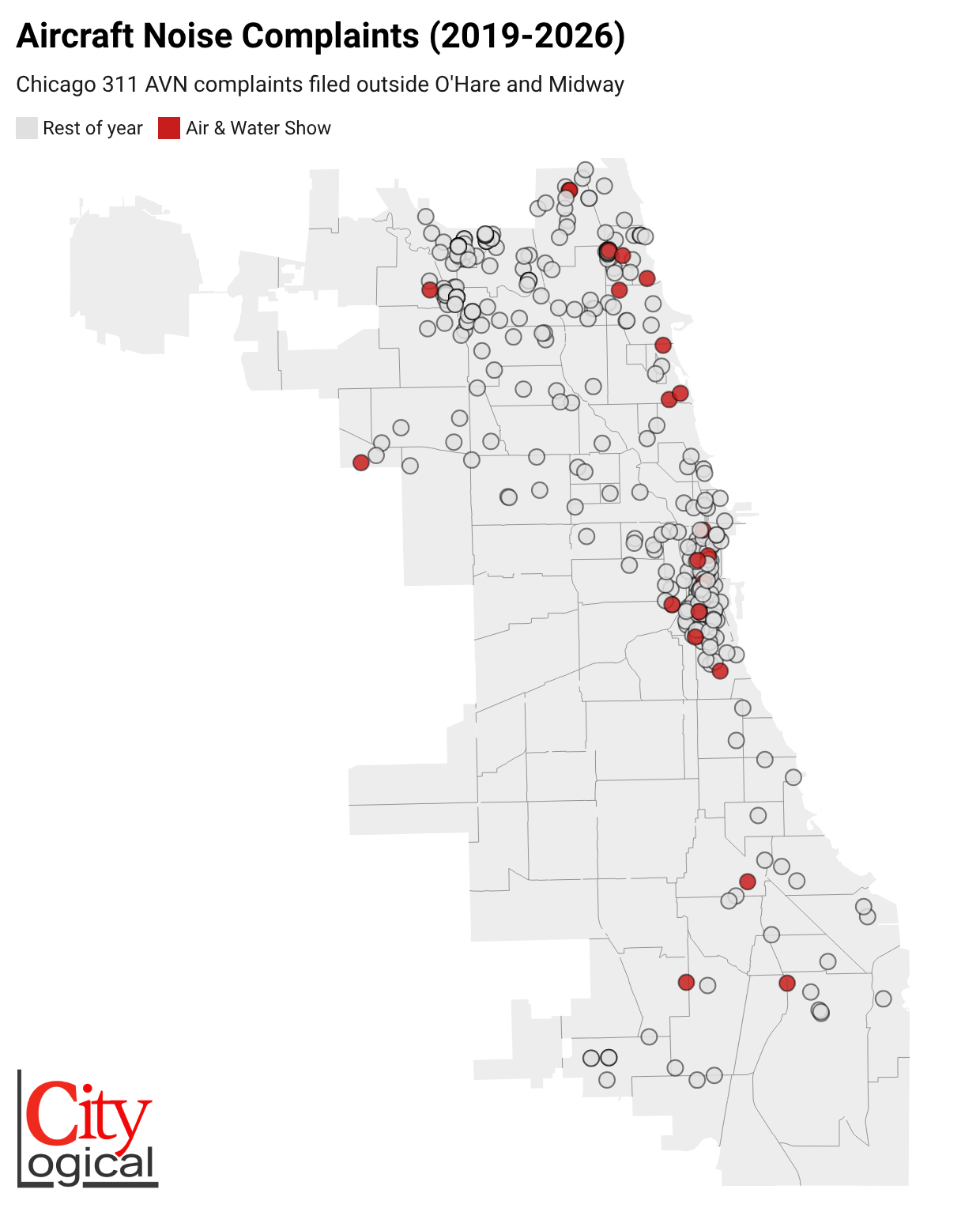
Those dots represent the location of 377 individual Aircraft Noise (AVN) complaints made to Chicago 311 since 2019, stripping out anything recorded within twelve kilometers of the two airports. 22 of those complaints were made during one of six Air & Water shows, so my initial hypothesis was correct: the city is six times more likely to receive an AVN complaint from outside the airports while the Thunderbirds or Blue Angels are overhead.
Uh, duh. I assumed there would be more data points to map. Maybe a heatmap showing their practice routes and the corridor along the waterfront. Only a measly 22 peeved pedestrians. The real story, it turns out, is at the airports.
Airplane Food
Over 2.5 million aircraft noise complaints—99.93% of all AVN complaints since 2019—are recorded to 10510 W Zemke Rd. That’s the Aviation Administration Building at O’Hare. Per the official record, the Chicago Department of Aviation (CDA) has filed 2.5 million complaints about itself.
Unlike most major cities, Chicago officially treats noise complaints as an emergency (911) issue. Unofficially, I have found this not to be the case, but that’s neither here nor there. Aircraft noise complaints, on the other hand, are handled as non-emergencies (311), even if they are made directly to the CDA.
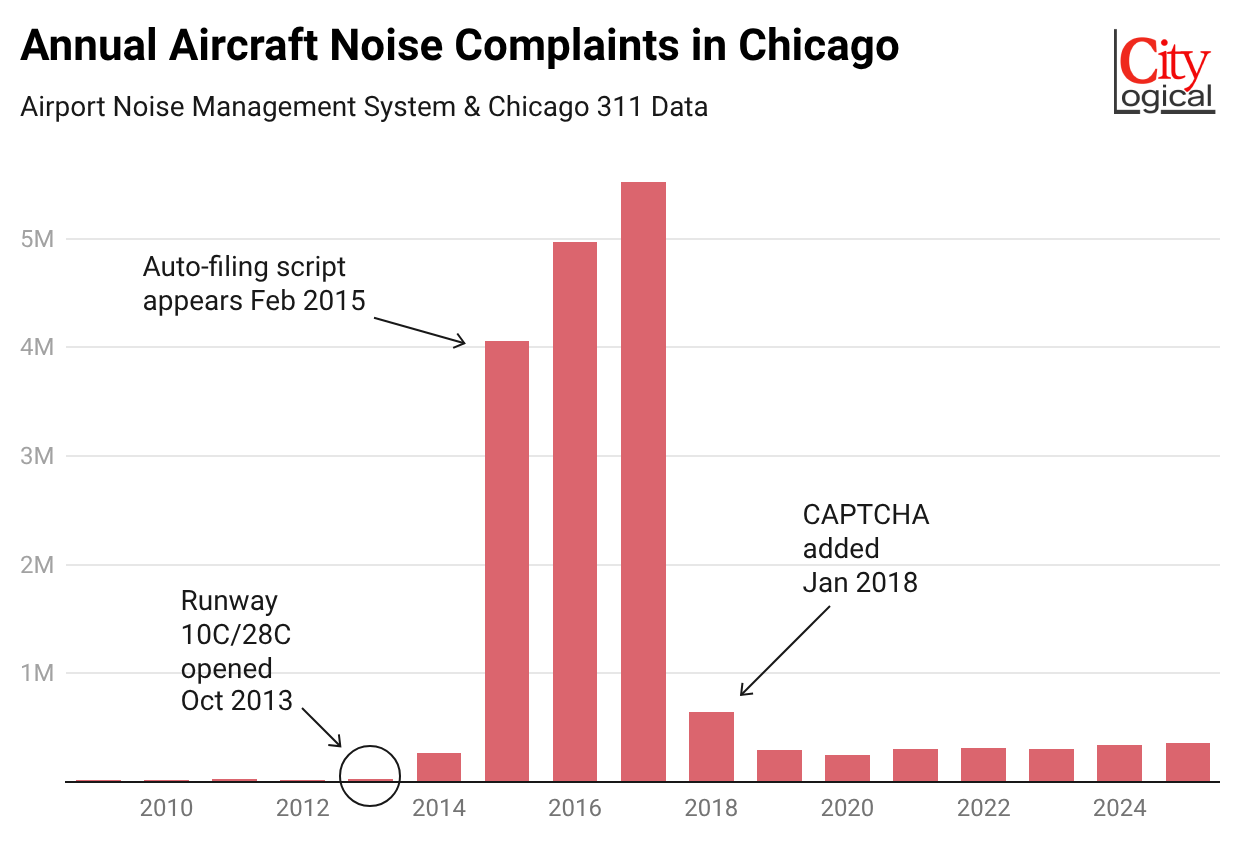
For years, O'Hare noise complaints were a small-town affair: about 15,000 made in all of 2009, even fewer in 2010, no more than a few an hour up until 2013. Then two things happened.
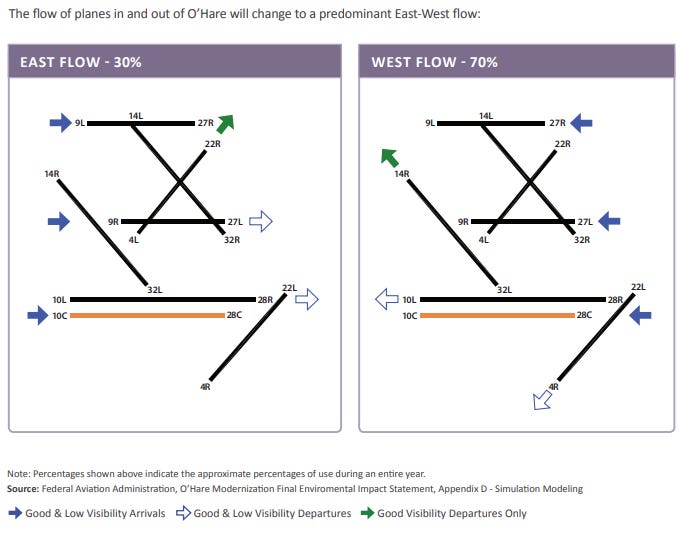
First, the runways moved. O’Hare’s modernization replaced its criss-crossing diagonal runways with parallel east-west ones. When runway 10C/28C opened in October 2013 after seven years of construction, traffic that used to fan out across the region was concentrated into two corridors—straight over Bensenville, Wood Dale, Itasca to the west, and Park Ridge & Chicago’s Northwest Side to the east. Complaints jumped 500% in the first full month, and 2014 finished with over 9x the number of complaints from the year before.
Then the machines arrived. “In February 2015, a citizen group created a software script to register aircraft noise complaints via the City of Chicago’s 311 site.” Complaints grew to absurd numbers. In its peak year of 2017, O’Hare logged 5.5 million complaints—one complaint every six seconds, six complaints for every departing and arriving plane.
To combat the rash of dubiously sourced complaints, the city deployed a CAPTCHA "to improve the performance of its 311 system by reducing the number of non-human submissions." It worked instantly: complaints dropped 87% from January 2018 to February 2018 and have since normalized to a few hundred thousand a year.
Button-Pushers
While no one has ever claimed responsibility for the bots, affected residents organized in 2013 into the Fair Allocation in Runways (FAiR) coalition and spent the next several years protesting the runway reconfiguration. The automated complaint script showed up right in the middle of their fight. There’s a whole cottage industry for this: Airnoise sells a Bluetooth button you keep on the coffee table. A jet goes over, you smack the button, it looks up the flight overhead and files the complaint for you. It's on its third hardware generation.
Why bother? There is a rich history of O’Hare neighbors being compensated for noise pollution. The Residential Sound Insulation Program started as a 10-home pilot back in 1995 and has since refurbed 12,000+ homes to the tune of over $385 million. If your home sits inside the official noise contour map, you may be eligible for a new door or window (search your address and scroll down to the City Logic section). Surprisingly, even with the runway flip in 2013, the official contour has actually shrunk since 1979, purportedly due to quieter jet engine models.
So complaint totals are residents’ loudest counter-assault. They get tabulated in monthly reports to the O'Hare Noise Compatibility Commission, cited in Federal Aviation Administration proceedings, and waved around in fights over sound-insulation money. And it kind of worked: the button-pushers never stopped the runway plan, but in 2016 the city appeased FAiR with a temporary Fly Quiet runway rotation plan.
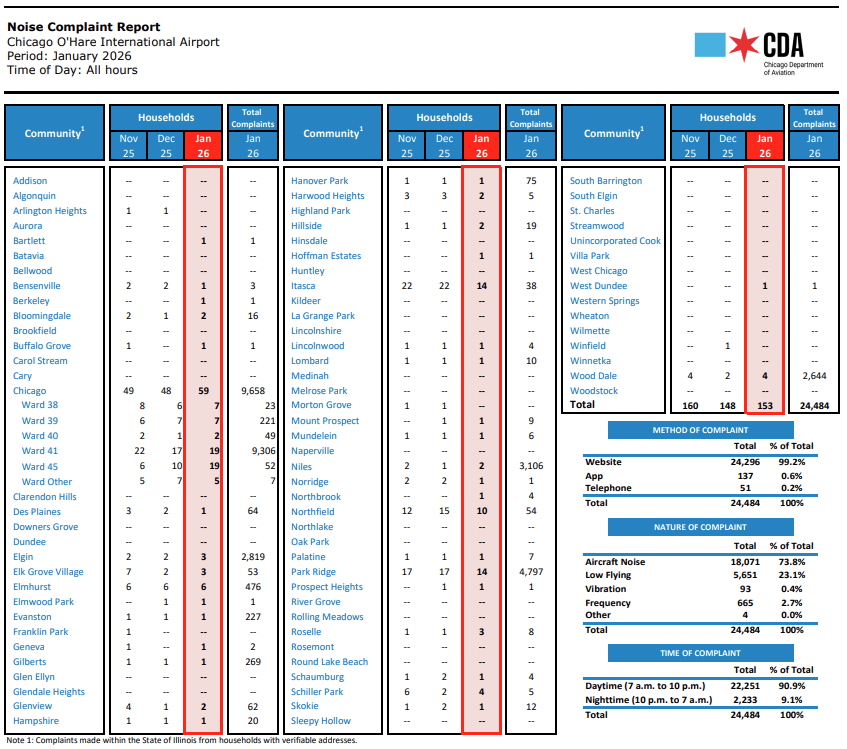
Every monthly report from the CDA includes a table of complaints by community alongside the number of households they came from. I’m pretty sure the 3,000 complaints in Niles are from my uncle-in-law, Billy. The public-facing 311 system, however, reroutes almost all AVN complaints to O’Hare (the only complaint type out of over 100, to my knowledge, which has its location changed).
What a Complaint Measures
So here’s the final scorecard for Chicago’s aircraft noise ledger.
The loudest weekend of the year—with fighter jets, on purpose, flying so low over a million people that car alarms go off—left three traceable complaints from the entire lakefront in 2025. A routine Tuesday in Itasca left two hundred from six households.
Remember the guy on the Thursday call? Eighteen of the twenty-two show-weekend complaints came during the practice and rehearsal days, not the shows themselves.
We cite complaint counts like they measure annoyance. Sometimes they don't. Sometimes they measure organization: who showed up to be counted, and who never knew there was a count. A million people heard the Thunderbirds that weekend and a single household in Gilbert out-complained them all.
This is the first City Logic story. Chicago's public data ledger is remarkably informative and there are many more stories to tell. All data used in this report are public on Chicago’s data portal.